Convergence Fellowship Program
Diagnose, Target, Adapt:
A Strategic Guide to Galvanizing Public-Private Investment in the Age of Transformative AI
By Raphael Gregorian, Jonathan Harris
February 05, 2026
How should governments invest in a world shaped by transformative AI? This paper sets out a practical framework for designing public and public-private investment mechanisms that align private incentives with societal value in the AI transition. Drawing on the economic principle of targeting, it diagnoses key investment distortions and shows how different mechanisms can be matched to different risks and objectives. The result is a clear, policy-ready approach for governments, philanthropies, and investors seeking to steer AI-driven growth toward broad social benefit.
Authors


Key Advisors


Originally Published
February 05, 2026
Research program
AI Economic Policy Fellowship: Spring 2025
This project was conducted in collaboration with fellows from the Future Impact Group.
Abstract
Steering society's transition to a world transformed by AI requires a focused approach to public-private investment. To address this challenge, we apply the ‘Principle of Targeting’ by first diagnosing the distortions that hinder progress in eight key AI investment areas and then considering four families of investment mechanisms, each targeted to specific distortions. Matching mechanisms to distortions gives policymakers, investors, and philanthropists a way to align capital with societal priorities, improving the odds of a broadly beneficial AI transition.
Executive Summary
Transformative AI is advancing rapidly, with the potential to reshape work, industry, and national capabilities. Yet unlike previous waves of technological change, this transition is unfolding with unprecedented speed and scale. Steering this transition toward a beneficial outcome, one where its gains are broadly shared and its risks are managed, requires investment at a scale and complexity beyond what the public or private sector can achieve alone. The 'Principle of Targeting' states that the most effective intervention acts directly on the 'distortion' holding investment back. While this principle is well-established in theory, it is chronically underutilized in practice, leading to blunt tools, wasted spending, and high-profile failures. In line with the principle, this report shows how to diagnose distortions and target them to address the challenges of the AI transition.
We consider eight key AI-related investment areas: Human Capital & Skills Development; Frontier AI Infrastructure; Digital Infrastructure & Access; Sectoral Adaptation & Resilience; Mission-oriented Innovation; Managing Environmental Externalities; AI Safety & Assurance; and National Security & Defence. In many of these areas, the binding constraint is a lack of coordination, not capital: distortions drive a wedge between private incentives and social value, stalling public-private collaboration. These distortions generally take two forms: externalities (e.g., benefits from training a worker spill over to future employers) and uncertainty (e.g., unclear technical payoffs, long horizons, volatile demand).
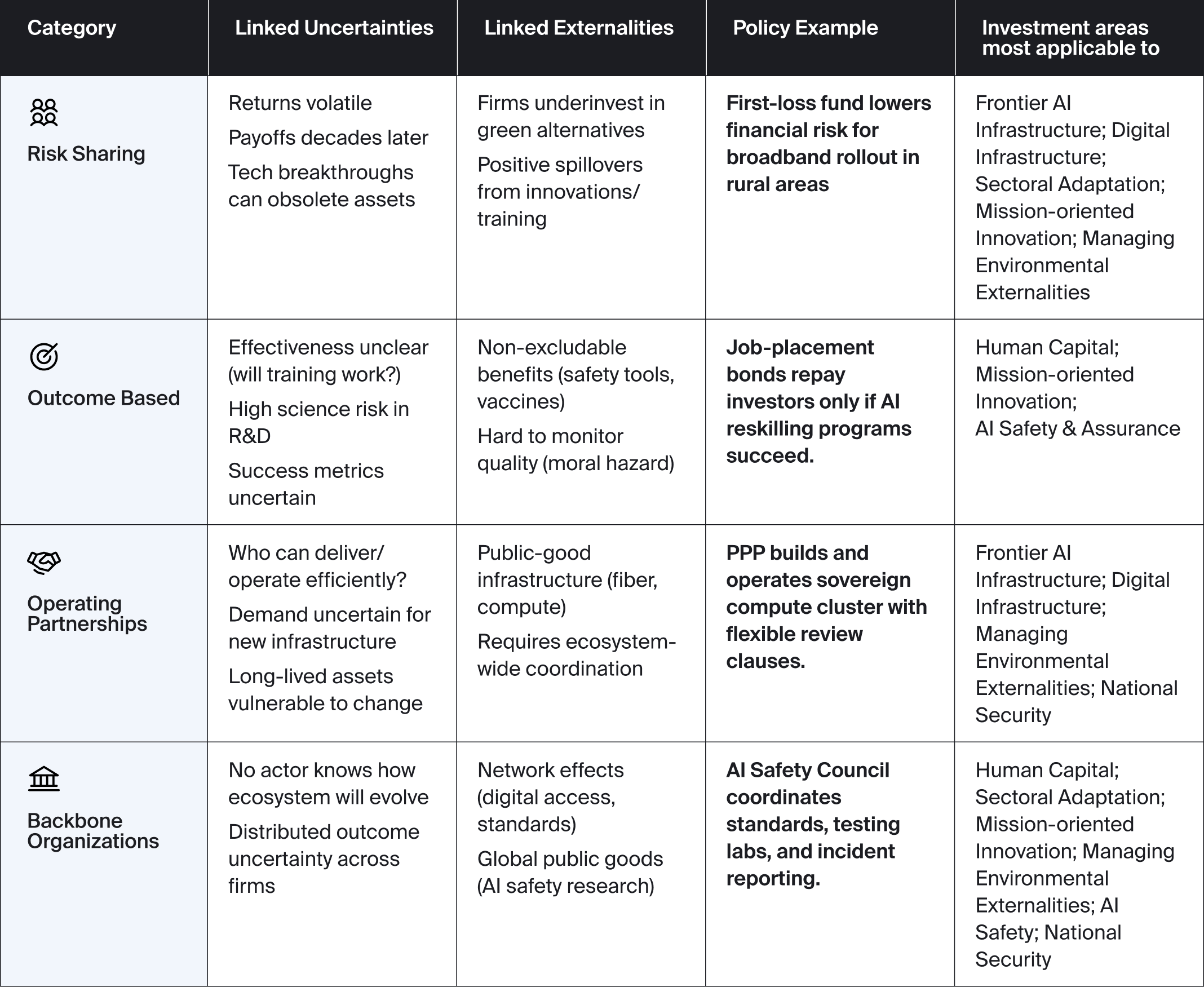
To target these distortions, we analyze four categories of mechanisms and assess where each is most effective:
Risk Sharing, such as first-loss capital, de-risks investment by using public or philanthropic capital to absorb specific risks and unlock additional private investment. For example, a government might guarantee the first 20 percent of losses to crowd in capital for AI-enabled healthcare innovation.
Outcome Based, like pay-for-success contracts, involves tying payments directly to measurable results, ensuring public funds are spent only on outcomes that address an externality. For example, a state could pay for a reskilling program only after graduates secure relevant jobs.
Operating Partnerships, such as public-private partnerships, coordinate the delivery of complex infrastructure over the long term. For example, a private consortium could be contracted to build and manage a national AI compute facility.
Backbone Organizations, like standards bodies or research consortia, are standing institutions that host and galvanize the collaboration needed to sustain coordination. For example, a multi-stakeholder institute could be formed to set safety and interoperability standards for AI in healthcare.
The table below summarizes each mechanism’s core features, the uncertainties and externalities it targets, a representative policy example, and the AI investment areas where it is most applicable.
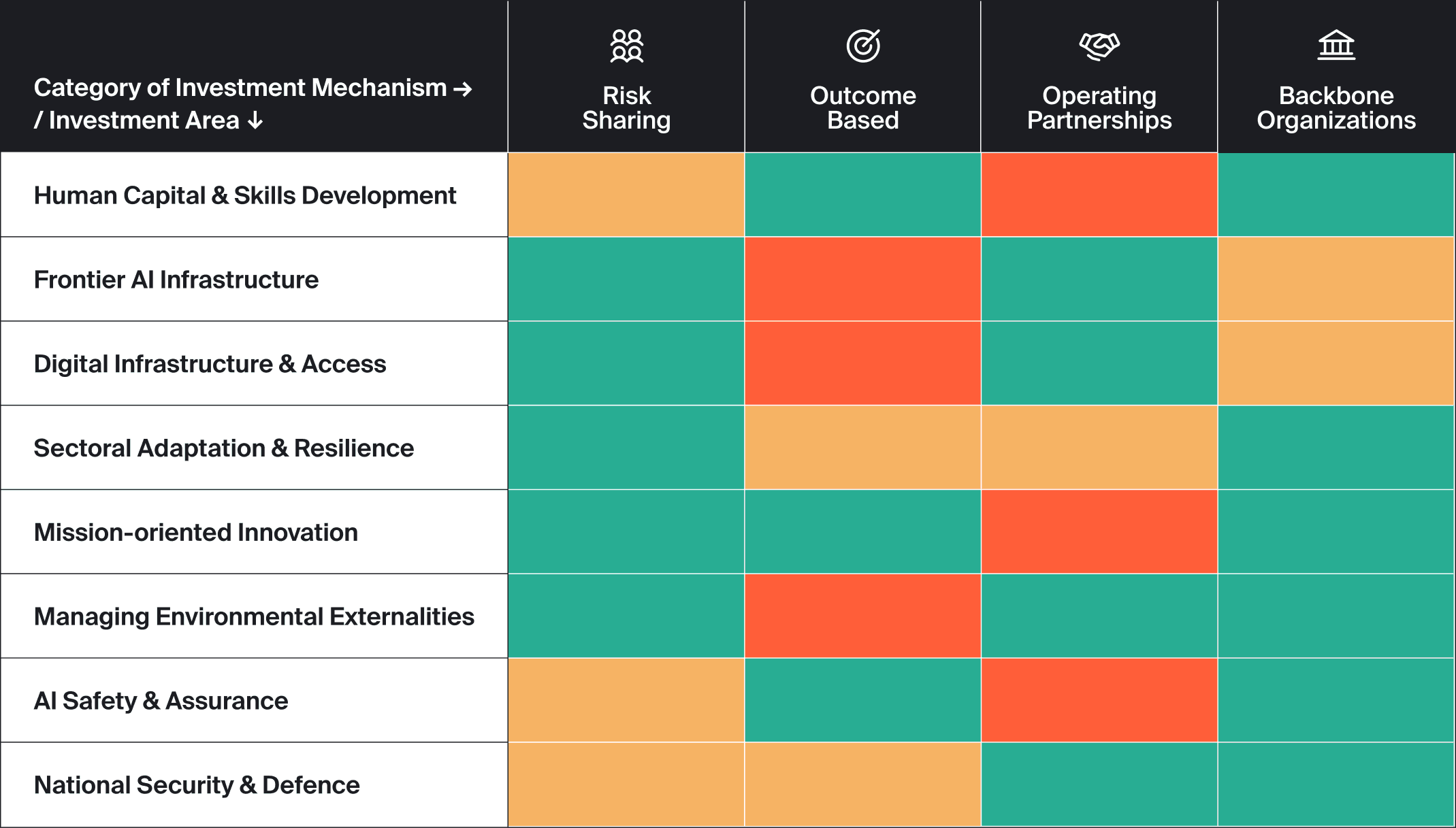
We diagnose the characteristic distortions in each investment area and match them to the mechanisms best suited to target them. The following table summarizes the results of this matching analysis. The colour-coding indicates whether a mechanism category has a strong, moderate, or limited fit for addressing the characteristic distortions of each investment area.
The following four examples illustrate how well-designed mechanisms can unlock stalled investment when they deliberately address the underlying distortions.
Climate Investor One (CIO) and the GAIA Platform (global green infrastructure) - Risk Sharing
Renewable projects in emerging markets often face high construction risk, slow payback periods, and climate benefits that private investors cannot capture. CIO and GAIA address this by using blended finance with public first-loss capital, absorbing early risk so commercial investors can participate. CIO has helped finance around 1.7 GW of clean energy capacity, while GAIA has mobilized over $1.3 billion for vulnerable regions. These cases show how targeted risk absorption can turn socially important but commercially marginal projects into investable ones.
2
Educate Girls Development Impact Bond (2015–18) in India - Outcome Based
Private investors funded a girls’ education programme upfront and were repaid only if independent evaluators confirmed improvements in enrolment and learning. The programme exceeded both targets, delivering strong returns for investors and enabling the NGO to scale. This demonstrates how outcome-based mechanisms can direct capital toward interventions that genuinely work, reducing uncertainty about performance.
3
Auvergne Regional Broadband PPP (France) - Operating Partnerships
Rural broadband often stalls due to weak commercial incentives and uncertain demand. The Auvergne PPP combined regional and EU funds with a private operator under a flexible 10-year concession that allowed regular adjustments as conditions changed. It achieved near-universal fibre coverage for 800,000 residents, something neither sector could deliver alone. This shows how adaptive operating partnerships can deliver infrastructure under high uncertainty.
4
Zorrotzaurre Redevelopment in Bilbao, Spain - Backbone Organizations
Transforming a neglected, flood-prone island into a low-carbon innovation district required long-term coordination across many actors. A permanent public-private commission provided this backbone role, aligning stakeholders, sequencing investments, and unlocking EU and private funding. Its success demonstrates how backbone organizations reduce coordination failures and enable complex, multi-decade transformations.
We recognize that making more targeted investments may be easier said than done. Real-world problems are rarely single distortions but complex mixes of challenges. Constraints, be they political, institutional, or fiscal, often prevent the 'first-best' solution and mis-matching a tool to a complex problem can cause real harm. Therefore, this report should be read as a guide, not as a rigid recipe book.
Three Questions for Targeted Investment
The discipline of targeting can be put into practice by asking three core questions in any investment context:
Diagnose: Have we identified all significant distortions at play?
Have we identified all significant externalities (i.e., unpriced costs and benefits)?
Have we identified all the uncertainties (e.g., where risk makes the investment unviable for a single actor)?
What frictions are preventing these distortions from being solved by the market?
2
Target: Does the proposed mechanism directly address the distortions?
Is the mechanism a direct solution to the root cause, or is it an indirect tool that might create unintended side effects?
For example: Is Risk Sharing being used for an uncertainty problem? An Outcome-Based instrument for a performance-risk problem? A Backbone Organization for a coordination failure?
If there are multiple significant distortions, does the mechanism have a sufficient number of features to address them all?
3
Adapt: Have we accounted for real-world constraints and context?
Are there unfixable political or institutional constraints? If so, have we considered the risk of making things worse by triggering 'second-best' effects and tailored the implementation accordingly?
Is the implementation of the mechanism truly tailored to the specific, local context with input from all key stakeholders?
In an era of rapid technological change, the ability to diagnose problems and deploy targeted mechanisms is more essential than ever. The upside of getting this right is significant: better aligned incentives, fewer failed projects, and a larger share of AI-driven value flowing toward broad-based prosperity rather than narrow gains. This report provides policymakers, investors, and philanthropists with a structured, evidence-based approach to design more targeted investment mechanisms that get more done.
Report Link
Newsletter
Get research updates from Convergence
Leave us your contact info and we’ll share our latest research, partnerships, and projects as they're released.
You may opt out at any time. View our Privacy Policy.